Penn Museum Native North America Gallery Opening

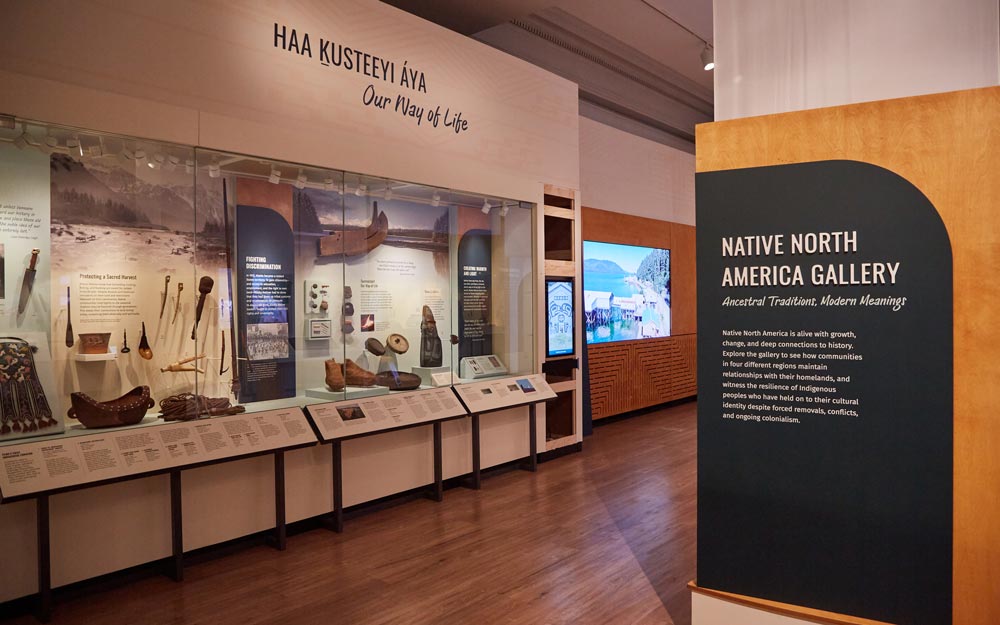
The opening celebration of the Penn Museum’s Native North America Gallery on November 22nd offered more than new glass cases, wall text, and curated artifacts. The most striking element was the emotional presence of the people whose histories the gallery aims to represent.
During her remarks, Raelynn Butler spoke about the reburial of Indigenous ancestors; work she described with a combination of grief, responsibility, and relief. When she paused and cried, the room shifted. It became clear that no matter how clinical institutions try to be, and no matter how far observers attempt to distance themselves from events that happened generations ago, these histories are not abstract. They involve people who endured hardship, and descendants who carry the weight of that experience.
After her talk, GPA had the opportunity to ask Butler how we can shift away from the familiar narrative that casts Native communities as passive victims in contrast to a more dominant population. She noted that both pity and dismissal flatten Indigenous nations into a single role. They obscure the complexity, resilience, and agency that define these communities. It underscored a larger issue: when we depersonalize any group in the past, we risk reinforcing that dehumanization in the present.
The gallery’s curatorial framing aligns with this point. Megan C. Kassabaum, Ph.D., of the Department of Anthropology at UPenn, described the exhibition as “designing archaeological artifacts to let you see real people, not just the way they were in the past.” This is not a small shift. It encourages visitors to perceive the material record, not as static evidence of a vanished culture, but as traces of living societies connected to families, land, and stories that continue today.
Kassabaum also emphasized that the exhibition “pushes Indigenous history into the public eye at a time where a lot of attention will be put on Philadelphia, positioning the gallery within the broader context of the city’s approaching 250-year anniversary.”
The performances that followed reinforced the centrality of connection. The Tewa Dancers from the North demonstrated dances rooted in the landscape, especially movements representing animals such as eagles and buffalo. For the performers, these traditions are also mechanisms of continuity within families. Andrew Garcia does not perform alone; he dances with his sister, several brothers, his mother, his aunt, and other relatives, making the practice itself a living family archive. Dance functions as an intergenerational bridge, repairing fractures caused by displacement and historical trauma through shared practice and artistic expression.
Music and storytelling by Tchin further extended this idea. His narratives, which explained, for example, why animals appear the way they do, were not meant as literal explanations of biology. They functioned as tools for understanding the natural world through relational meaning.
This mode of knowledge-making treats nature not as something to observe at a distance but as something to engage with through narrative, humor, and interpretation. The making of narrative itself creates a participatory orientation toward the natural world that increases one’s sense of belonging within it.
Taken together, the day highlighted a core theme: connection is not sentimental; it is structural. Our connections to ancestors shape our understanding of responsibility. Our connections to stories influence how we interpret the world around us. Our connections to nature inform our sense of place and our values. These ties do not simply preserve identity. They create it.
There is a familiar warning that those who ignore history are doomed to repeat it. But the greater risk lies in dehumanizing the people within that history. When we view others’ ancestors as abstractions, and our own histories as distant or irrelevant, we reinforce a narrative of separation. That separation allows violence (social, cultural, and environmental) to persist. The opening of the Native North America Gallery made clear that the correction is not only to remember history, but to recognize the human-nature continuity that binds past and present.
The University of Pennsylvania Museum of Archaeology and Anthropology is a GPA Member and a key partner in advancing understanding of the world’s cultural heritage.
